

A business can become dependent on its founder in familiar ways. Decisions flow upward. Difficult problems land on one desk. Everyone knows where the final answer lives.
But there is another direction of dependency worth examining: the founder can become dependent on the business, too.
Not merely for income. For identity. Purpose. Accomplishment. Status. Security. The feeling of being needed. The feeling that comes from building something that matters.
When the business needs the founder and the founder needs the business, the relationship can become founder codependency. And eventually, it can become structural. It affects how authority is distributed, how people make decisions, how information moves, and whether the organization can grow beyond the people who built it.
Key Takeaways
Founder codependency develops when a business and its founder become mutually dependent.
Founder identity can shape decision-making, authority, ownership, and information flow throughout the organization.
Systems improve consistency but cannot change a founder’s relationship with the business.
A short detachment exercise can reveal roles, decisions, and authority the founder can begin releasing.
About this article. The video is the original work. This written version was generated by AI from its transcript and I have edited it only lightly, so read it as a companion to the video rather than as something I wrote. The argument and the spoken words are mine. The prose in this article is not. The video is at the bottom of this post.
When a Role Becomes Who You Are
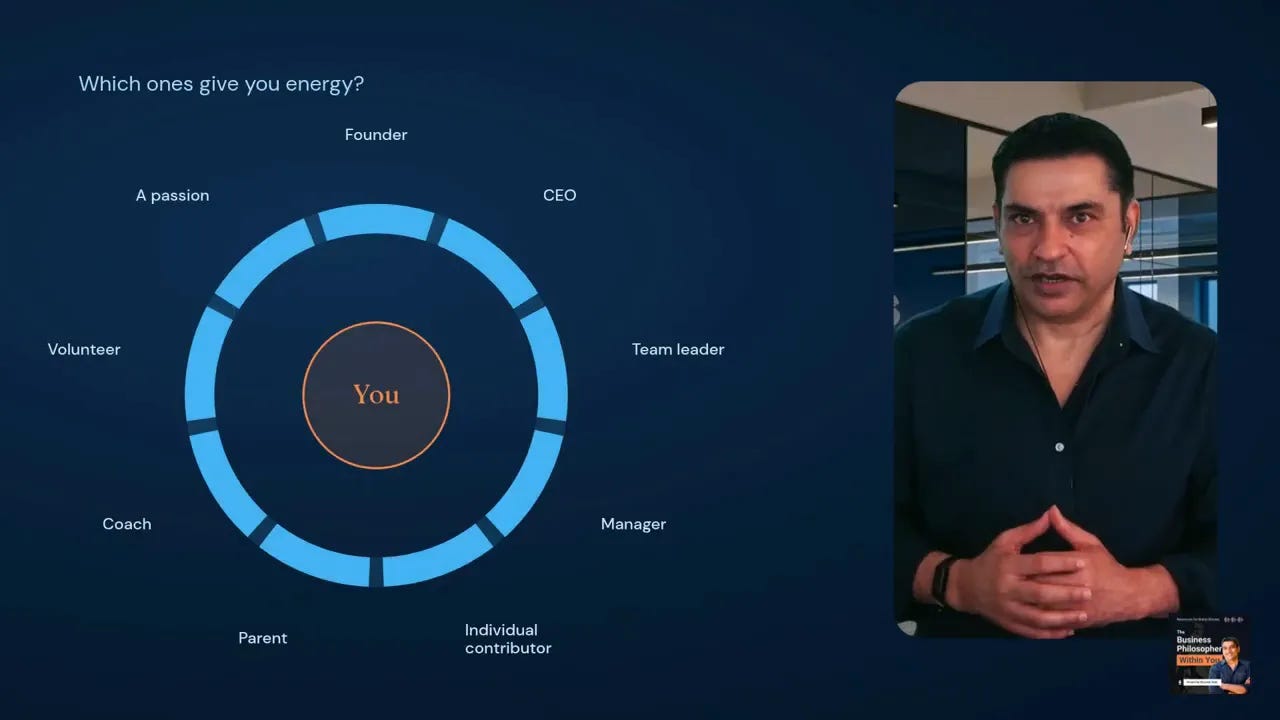
Think about the roles you play: founder, CEO, manager, leader, parent, coach, volunteer, specialist, or something else entirely.
Some roles are simply things we do. Others slowly become part of how we see ourselves. You do not just work in finance, you are a banker. You do not simply manage people, you are a manager. You do not just build a company, you are a founder.
There is nothing inherently wrong with that. Deep identification is often what makes commitment possible. It gives you energy, responsibility, and the willingness to protect and improve what you have built.
But there is a question worth sitting with: which role would be hardest for you to give up?
That question matters because the harder it is to imagine releasing a role, the more likely it is that role has moved beyond activity and into identity.
The Difference Between Playing a Game and Building a Business
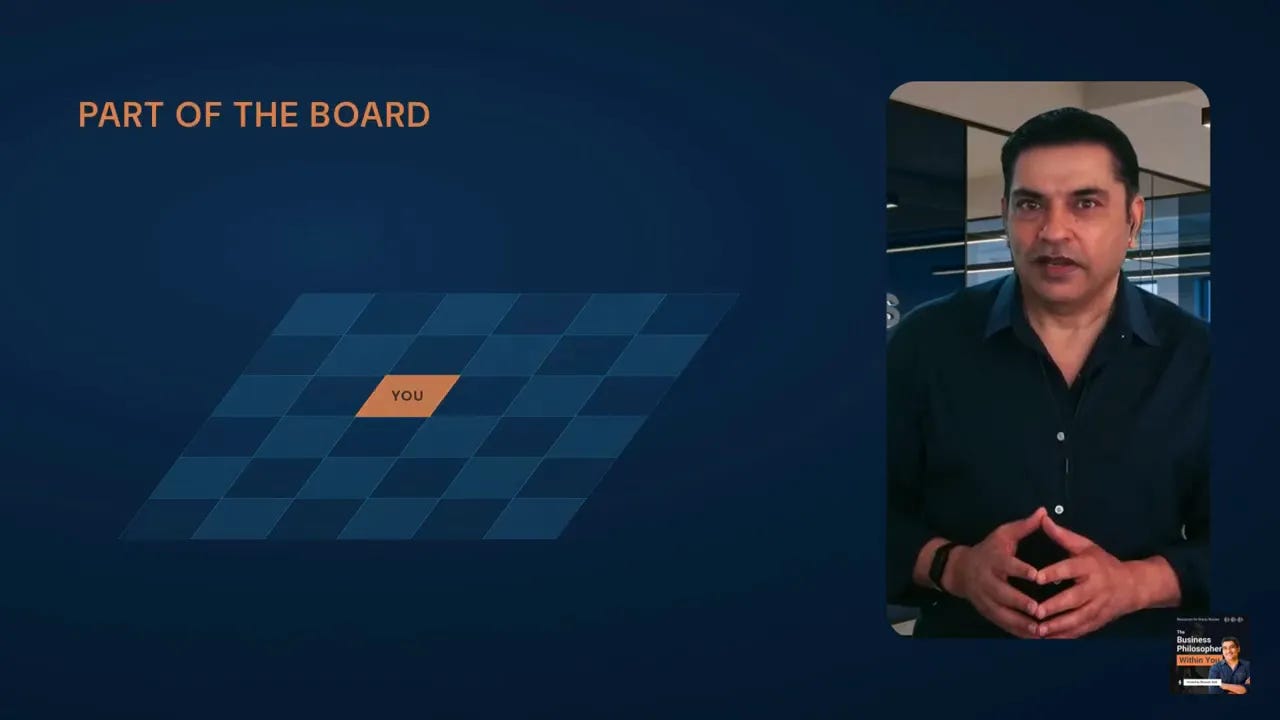
In a game of chess, you are outside the board. The board, pieces, and rules exist apart from you. You can leave, come back tomorrow, or play a different game. The game continues to exist.
Building a business is different. You are not only playing the game. You are helping create it.
You may be setting the rules, deciding who has authority, defining what gets rewarded, shaping culture, building the team, and deciding what the organization stands for. You are building the board while trying to play on it.
The longer this continues, the more you become invested. Your money, time, energy, reputation, relationships, and identity can all become intertwined with the business.
This is where ownership becomes powerful, and complicated.
Ownership Is a Strength
When you own something, it can feel like an extension of you. Your home, your profession, your family, and your business can all carry that feeling.
Ownership creates commitment. It creates responsibility. It gives you energy to care, improve, protect, and sacrifice. Those are not weaknesses. They are often founder strengths.
But when the business becomes an extension of you, threats to the business can start to feel personal:
A bad quarter feels personal.
An employee leaving feels personal.
A challenge to a decision feels personal.
Stepping away feels like stepping away from part of yourself.
The issue is not ownership. The issue is whether ownership has become so fused with identity that the organization cannot operate without keeping you at the center.
What Founder Codependency Looks Like
Founder dependency happens when a business depends on its founder for decisions, direction, problem-solving, and escalation.
The founder becomes the person everyone goes to. The person who knows the history, understands the customers, makes the difficult calls, and resolves uncertainty. Eventually, the founder becomes the bottleneck.
Founder codependency happens when that pattern runs in both directions. The organization relies on the founder, while the founder relies on the organization for something personally significant.
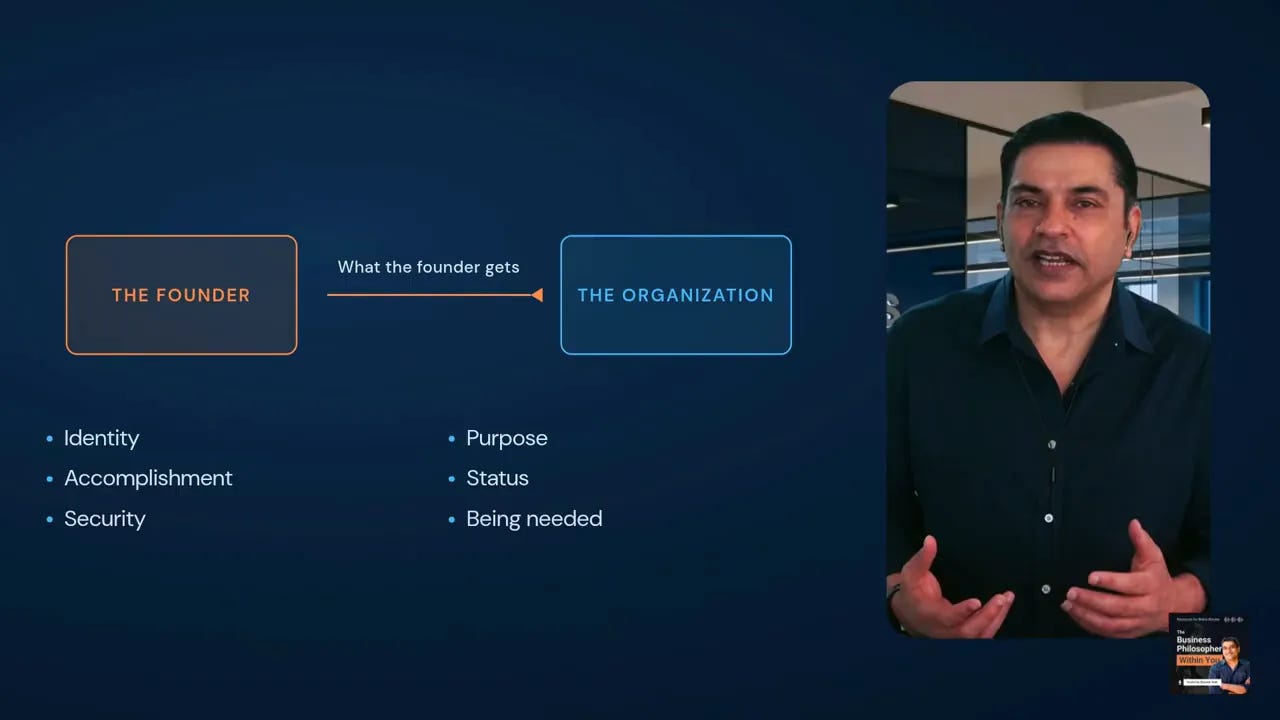
The business may provide the founder with:
Identity and purpose
Accomplishment and status
Security and belonging
A sense of being needed
Meaning from building something important
Again, none of these are automatically bad. In fact, they may be exactly what helped build the company. The problem begins when the mutual dependency becomes the operating pattern of the organization.
How the Pattern Develops
Founder codependency rarely begins as a conscious decision.
At the beginning, the founder makes decisions, solves problems, hires people, teaches the team, and builds trust. That is normal. In an early-stage company, it is often necessary.
Then the company grows. More people join. More decisions need to be made. More issues emerge. Because the founder knows the strategy, customers, history, and previous mistakes, people naturally look to the founder for answers.
The founder steps in. The problem gets solved. The team receives clarity. The business keeps moving.
And it feels good.
The organization learns that the founder is where problems go. The founder learns that being the person who solves the problems is rewarding. Each response reinforces the next.
Eventually, it is no longer just a behavior. It becomes a relationship pattern shared by the founder, the team, and the organization.
When Identity Starts Running the Org Chart
Your relationship with the business does not stay inside your head. It can shape the structure of the business.
If you see yourself as the person who must make the important decisions, decisions will continue to flow toward you. If you see yourself as the person who solves the difficult problems, difficult problems will keep arriving at your door. If you see yourself as the person who ultimately owns everything, ownership may never fully move into the organization.
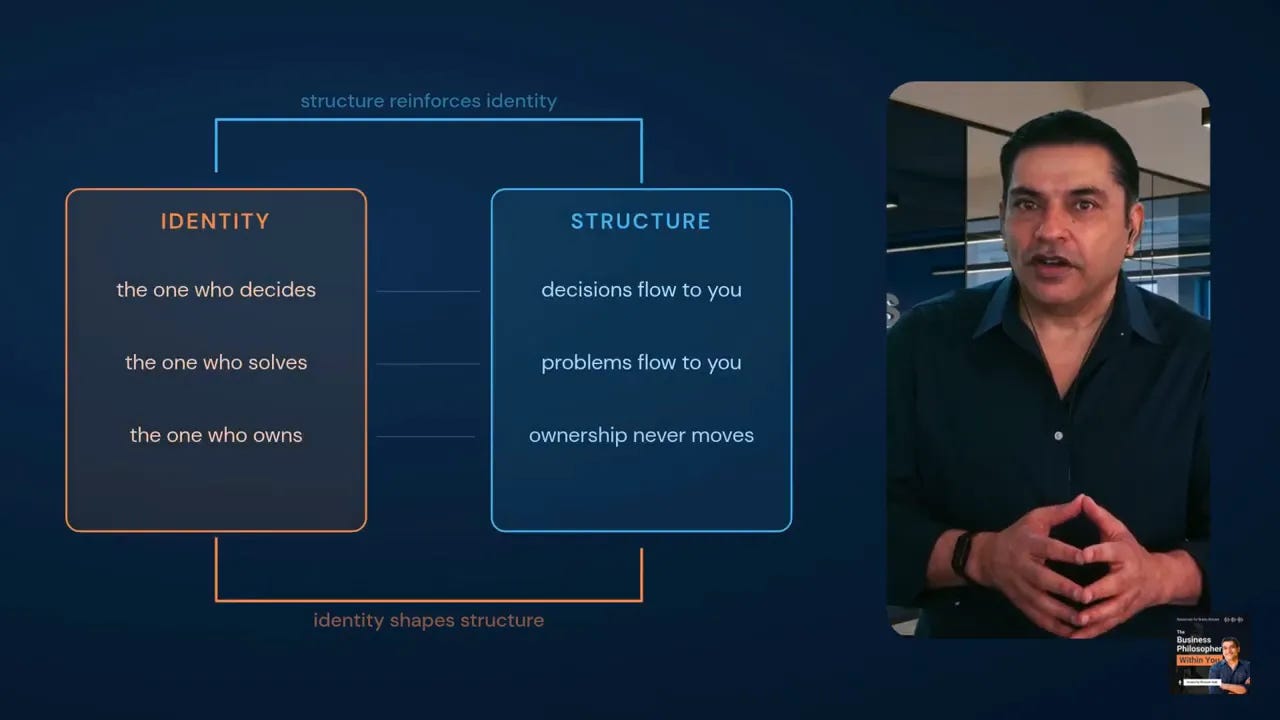
This creates a loop:
Your identity influences where authority, decision-making, and ownership sit.
The resulting structure teaches people to bring decisions and problems back to you.
That dependence confirms your identity as the central problem-solver.
The cycle continues.
This is why changing only your mindset is not enough. It is also why redesigning only the org chart is not enough.
You need both: a new relationship with the business and structural changes that allow that relationship to take hold.
Why Systems Alone Cannot Solve Founder Dependency
Systems are useful. They create consistency, clarity, and efficiency. They reduce unnecessary variation and can help a business operate more reliably.
But systems cannot decide what your business means to you. They cannot tell you who you are without the business. And they cannot prevent you from stepping back into the center every time uncertainty appears.
You can build more systems and still have a founder-dependent organization if the deeper relationship has not changed.
That is because people learn where authority really lives. They learn whose opinion matters most. They learn where the final answer comes from. Nobody may have explicitly designed it that way. It simply emerges through repeated experience.
Dependency Can Repeat at Every Level
This is not solely a founder issue. Dependency can form anywhere in the organization.
A senior executive can become the person nobody can operate without.
A manager can become the person every decision must pass through.
An individual contributor can become the only person who understands a critical process.
A team can become dependent on a particular person for confidence, knowledge, or direction.
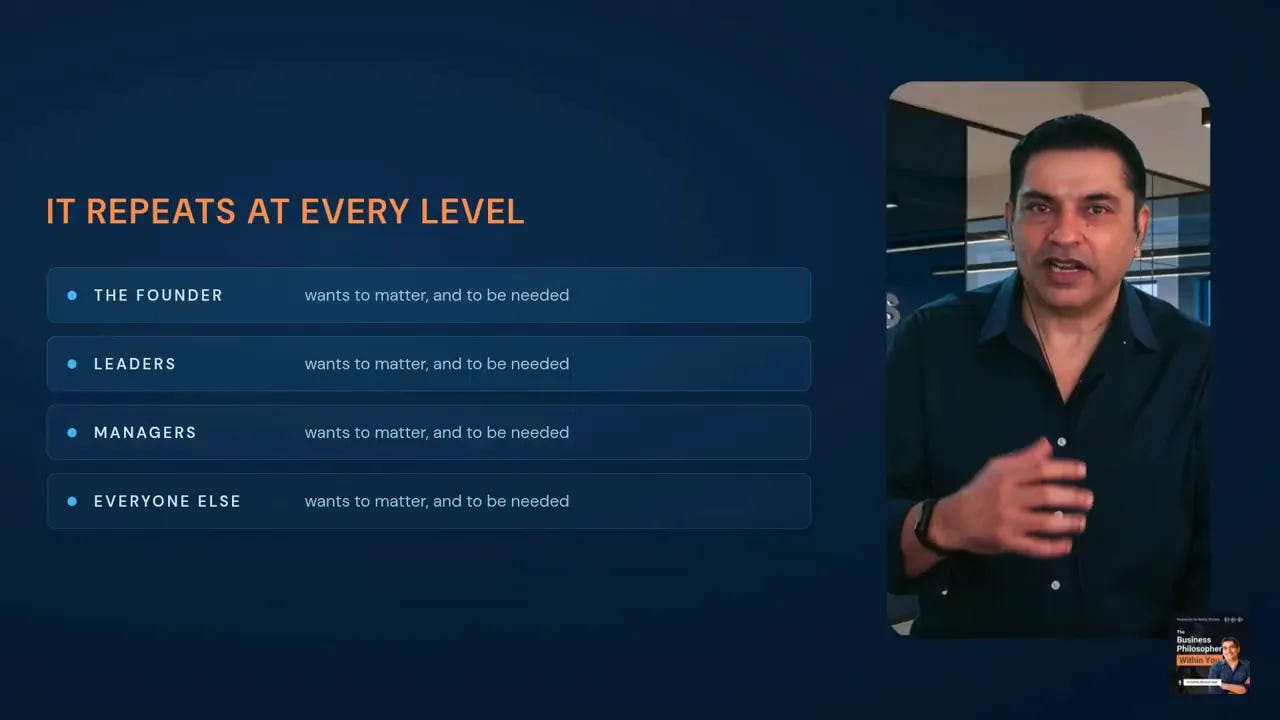
People can also become dependent on the organization for much more than a paycheck. Work can provide identity, belonging, accomplishment, security, and meaning.
So the real question of organizational sustainability is not simply whether the founder can leave.
It is whether people can contribute deeply without becoming indispensable. Whether they can take ownership without becoming trapped by it. Whether they can be important without becoming the only person who can make progress possible.
Create Space Between Identity and Role
The first shift is recognition.
You may be dependent on the business. The business may be dependent on you. Those two dependencies may be reinforcing each other.
Once you see the relationship, you can begin creating space:
Space between yourself and the business
Space between identity and role
Space between ownership and control
Space between responsibility and being indispensable
That space matters because it makes room for other people to think, decide, and take responsibility. It gives the organization room to develop its own identity and capacity.
It also gives you room to discover who you are when you are not required to be the person at the center of everything.
A 20-Minute Exercise to Begin Detaching
This is not about selling the company, disappearing for two weeks, or immediately hiring a COO. It begins with something much smaller.

Step 1: Leave Your Normal Place of Work
Physically remove yourself from your usual work environment for about 20 minutes. Take a pen and paper.
If you work in a commercial building, go outside the building. If you work from a home office, go somewhere with some distance from it. A nearby café, park bench, or quiet place will do.
The physical separation matters because it interrupts the normal environment that continually reinforces your role.
Step 2: Imagine You No Longer Own the Business
For those 20 minutes, pretend you no longer own the company.
Perhaps you sold it. Perhaps it was acquired. Perhaps you handed it to someone else. The particular scenario does not matter as much as allowing yourself to enter the experience.
Imagine the sights, sounds, and feelings. Where are you? What does your day look like? What do you hear? What would be different if the organization continued without you as its owner?
Step 3: Write the Feelings That Arise
Write down the exact words that describe what you feel. This does not need to be polished writing. It is not an exercise in producing a perfect reflection.
You might feel:
Relieved
Anxious
Excited
Empty
Lost
Free
You may feel several of these at the same time. The point is not to judge the response. The point is to notice it.
Step 4: Take One Tiny Act of Detachment
Return to work and take one small physical action that creates a little distance between you, the founder, and you, the person.
Keep it extremely small. You are not making a dramatic change. You are practicing the possibility of separation.
Leave at 7:25 instead of 7:30.
Set an alarm and call someone with no connection to the business.
Eat lunch somewhere other than your desk.
Decline a minor decision that someone else can make.
Ask a team member what they recommend before giving your answer.
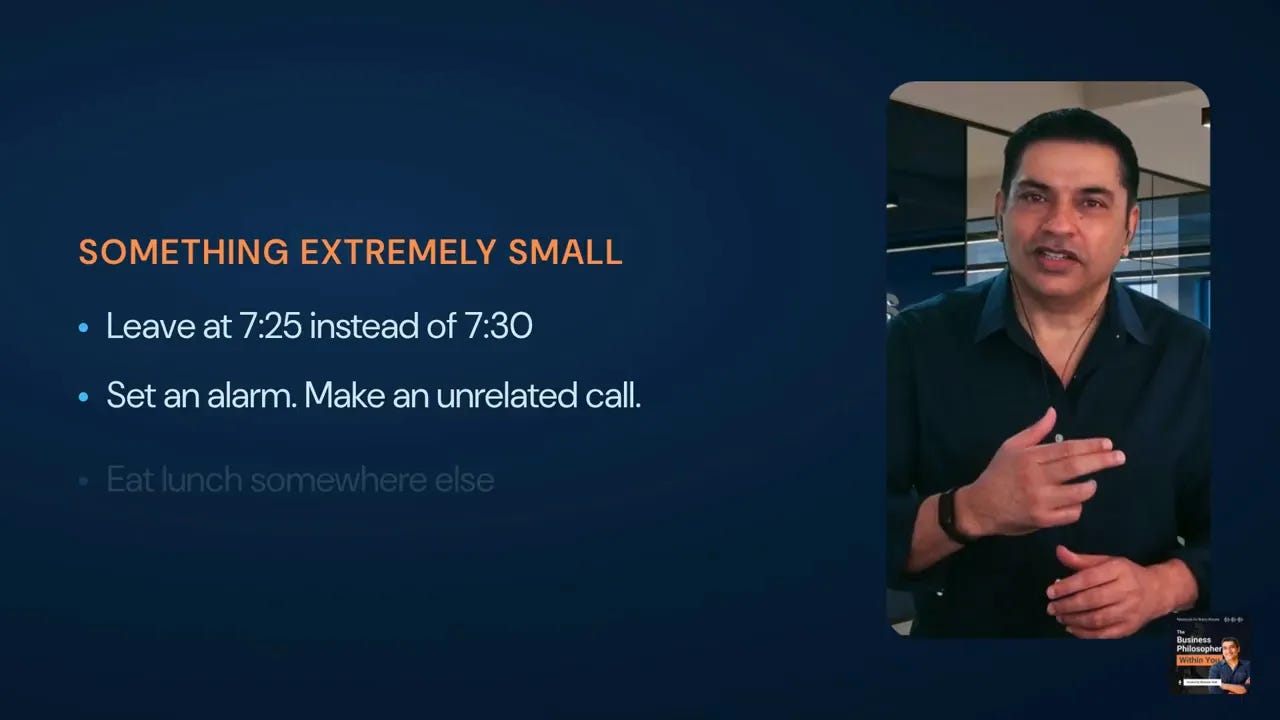
Then pay attention to what happens.
Why Twenty Minutes Can Matter
Twenty minutes away will not fix a business. That is not the point.
What it can do is create a small gap between you and the organization, between your identity as a person and your identity as a founder.
Inside that gap, you may notice something you could not see while fully immersed:
A different idea
A different problem
A role you have been holding too tightly
A decision that does not need to come to you
An area where someone else could have more authority
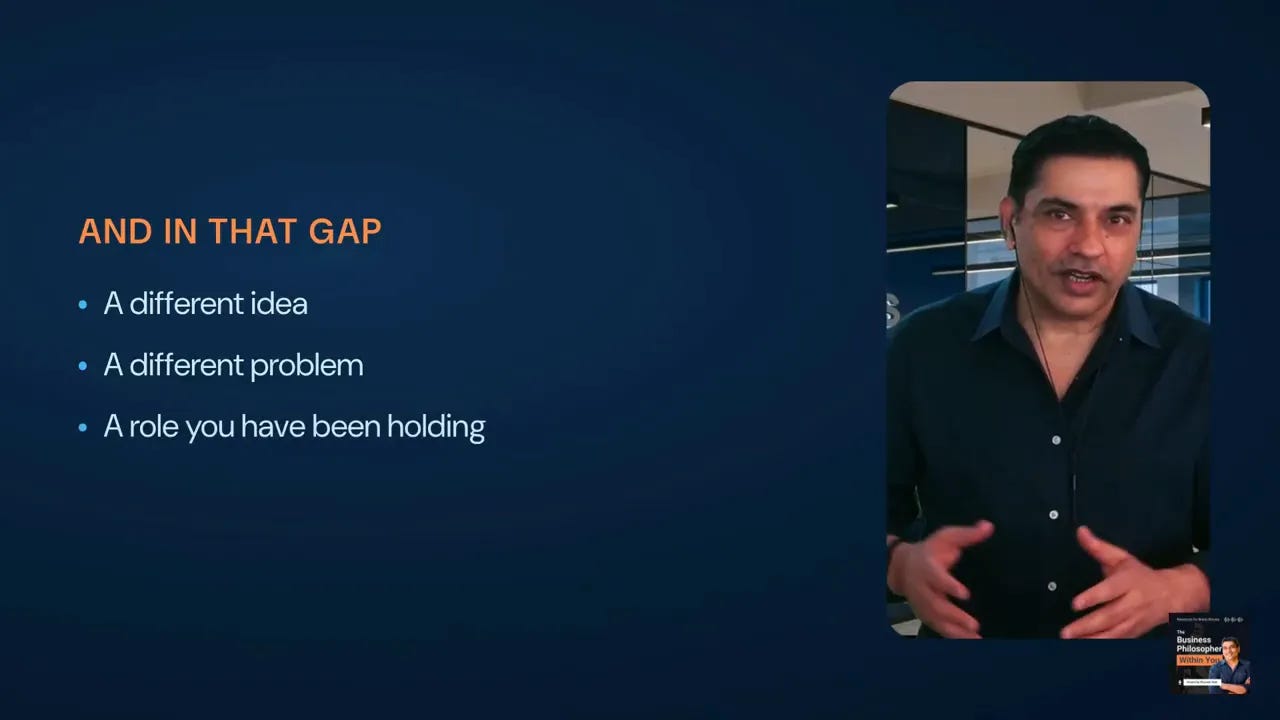
The exercise creates awareness. Awareness makes structural change possible.
Then the new structure can reinforce the change in you. You become less dependent on the business. The business becomes less dependent on you. Other people become more capable of thinking, deciding, and adapting without pulling you back into the center.
That is the reinforcing cycle worth building:
Create a little distance.
Use that distance to notice patterns.
Shift authority, decision-making, knowledge, and ownership.
Allow the structure to create more independence.
Use that independence to create even more space.
Who Really Owns Your Business?
Legally, ownership may be straightforward. But there is a deeper question.
Who feels ownership?
Who feels responsible? Who experiences the organization’s success as their success? Who sees its problems as their problems? Who has made the organization part of who they are?
Real ownership can create engagement, responsibility, and commitment throughout a company. But it also raises a difficult question: can you own something without allowing it to own you?
That question belongs to founders, leaders, managers, and every person who wants to contribute meaningfully without becoming trapped in indispensability.
Build an Organization That Can Thrive Beyond Its Founder
A self-sustaining organization is not one where nobody cares. It is one where people care deeply without one person becoming the center of all capability, authority, and meaning.
It is an organization where ownership is shared, authority is clear, knowledge moves, and people can solve meaningful problems without waiting for the founder to make every important call.
Founder codependency can constrain growth because the relationship becomes structural. It determines how decisions happen, where authority sits, how people respond to uncertainty, and how much capacity the organization can develop beyond its founder.
The first move does not have to be dramatic.
Notice the relationship. Create 20 minutes of space. Take one small action. Then see what becomes visible.
Sometimes the first step toward changing an organization is changing the space between yourself and the organization.
For a deeper exploration of this idea, read the founder codependency deep dive.
About this article.
This article was created from an original video titled “Why Your Business Can’t Grow Beyond You” on the The Business Philosopher Within You podcast (embedded below).
The video is the original work. This written version was generated by AI from its transcript and I have edited it only lightly, so read it as a companion to the video rather than as something I wrote. The argument and the spoken words are mine. The prose in this article is not.


