

Think of two people in the same company, in the same building, earning roughly the same paycheck.
One notices what is about to break. They stay with a problem longer than anyone expects. They take pride when the team wins, and they feel it when the work falls short.
The other does the job, goes home, and leaves whatever happens to the business at the business.
Same company. Completely different relationship with it.
That difference is not always about work ethic, talent, compensation, or whether someone has been told to “act like an owner.” It is often about something deeper: whether the work has become psychologically theirs.
Key Takeaways
Psychological ownership is an internal relationship that legal or financial ownership cannot guarantee.
Ask what someone would think first, then ask how they would feel.
Thought, feeling, and action reinforce one another until ownership becomes increasingly automatic.
Healthy ownership requires discernment so commitment does not become territoriality or defensiveness.
About this article. This is episode 50 of The Business Philosopher Within You podcast, Psychological Ownership. Why Your People Don’t Feel It the Way You Do. The video above is that episode. The YouTube version is at the bottom of this post.
The video is the original work. This written version was drafted by an AI tool, videotoblog.ai, from the recording, and I edited it only lightly, so read it as a companion to the conversation rather than as something I wrote. The questions and the frame are mine, and everything in quotation marks is the guest’s, said the way they said it. The prose here is not mine.
Start With the Question Founders Rarely Ask Themselves
Many founders ask why their people do not feel ownership the way they do. It is a fair question. But before pointing it outward, turn it around.
When you started the business, how much did you feel like an owner? And where are you today?
Do you feel more like an owner now, or less?
Your legal ownership may not have changed at all. You may still own the same shares, hold the same title, and carry the same responsibilities. But psychological ownership moves. It has ebbs and flows. There are seasons when the business feels deeply personal, and seasons when it feels distant, heavy, or merely demanding.
There is no right answer. There is only a question worth asking, because the more clearly you can see ownership in yourself, the better you can recognize it in other people.
A 20-Minute Conversation That Makes Ownership Visible
Here is the practical action.
Choose one direct report. Not your strongest person. Not the person giving you the most trouble. Just one person. Find 20 minutes together, in person if possible.
You are not trying to rate them. You are not administering an employee engagement survey. You are trying to help them look at their relationship with the business.
Take money off the table first
Start with the lighter version of the conversation. Ask them to imagine they have just won a $100 million lottery. Taxes are paid, the money is in the bank, and their financial security is taken care of.
Then ask: How long would it take before you came to me and said you quit?
They may laugh and say ten minutes. That is fine. The answer is not the point. The question removes money from the conversation, which is exactly what you need before moving to the real exercise.
Now set up a second scenario. Their income is secure. Their family is secure. Their health insurance is secure. Nothing about their financial or physical safety is threatened.
But this time, the business is gone.
Ask these two questions in this exact order:
What is the first thing you would think about?
How would you feel?
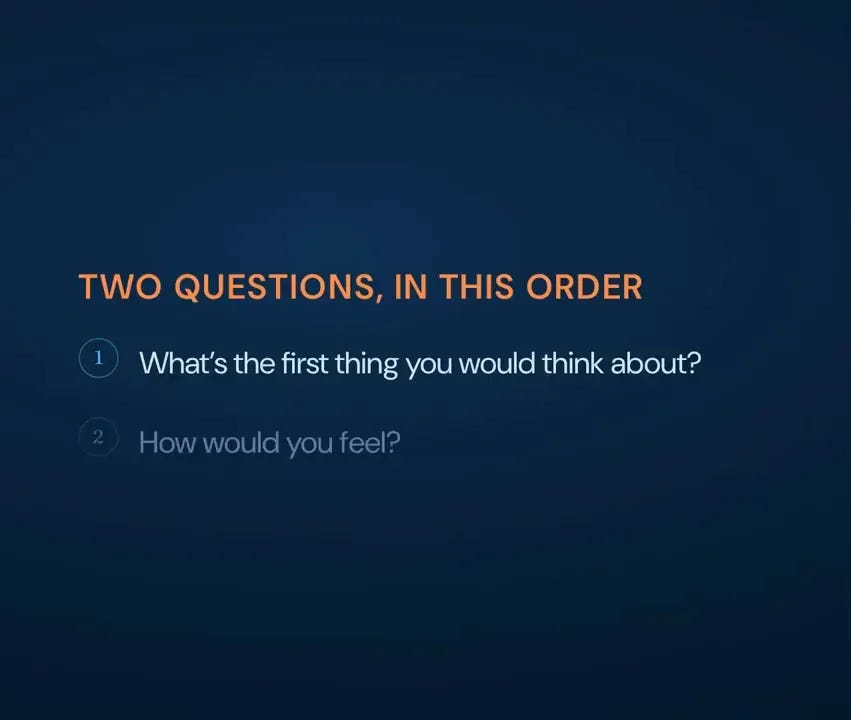
The sequence matters. If you lead with “How would you feel?” people may not know how to answer, or they may simply offer the answer they believe you want. Ask what they would think first. Let them say something out loud. Then ask about the feeling.
Do not help them find an answer. Let them sit with it.
Now run the scenario in the other direction
Keep the same rules. They are secure regardless of what happens. This time, though, the business doubles. Revenue doubles. Profit doubles. The things both of you care about are moving in the right direction, and they played a meaningful part in making it happen.
Ask the same two questions:
What is the first thing you would think about?
How would you feel?
Again, you are not looking for a specific word. You are not collecting approved answers.
Watch what happens while they answer
The real information is in what happens as they search for the answer.
Do they pause before speaking?
Do they look toward you or away?
Does their voice change?
Do they answer quickly to get past the question?
Do they give far more detail than the question required?
Someone can say they would feel terrible and be entirely unmoved. Someone else can say, “I don’t know,” while it visibly lands on them.
You are not collecting answers. You are watching what happens to them.
The result is not a score. It is a reading of how much of the business someone actually experiences as theirs.
Why Equity Alone Cannot Create Ownership
Equity, shares, options, profit sharing, bonuses tied to the numbers, and plans that let people participate in what the company earns are not mistakes. They are often fair, right, and long overdue.
But they all exist outside the person.
A share certificate is a legal fact. A bonus is a financial fact. The building, equipment, laptop, and keys are physical facts. All of these things matter. None of them guarantees the inner relationship we are actually trying to create.
People can care fiercely about a volunteer group, a side project, a cause, or a parent-teacher organization without receiving equity in any of it.
That points to another kind of ownership, one that can be stronger than the legal kind: psychological ownership.
Psychological ownership has been studied in organizational research since the early 2000s. A useful starting point is the foundational research on psychological ownership in organizations. The important point here is simple: the feeling of “this is mine” lives inside a person. It cannot be issued on a certificate.
How Something Becomes Psychologically Ours
Ownership follows a basic loop. It begins with a sense of self: me, I, this person.
Then comes a thought: This is mine.
That thought may happen so quickly that you never catch it consciously. You may think ownership started with doing the work. But before the hand moves, a thought has formed. A project, team, problem, or company crosses a line from “out there” to “mine.”
Once that thought is in place, feeling follows. You begin to care about what happens to the thing. Not professionally care. Actually care.
And when you care, you behave differently. You stay with the problem for another 20 minutes. You notice the issue no one assigned you to notice. You send the message on a Sunday because something needs attention.
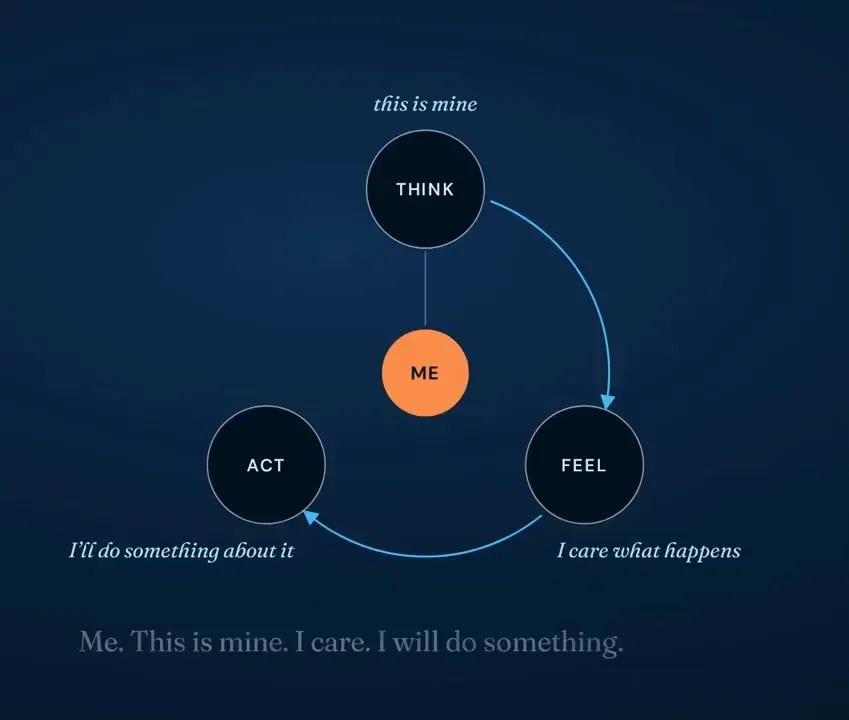
The loop looks like this:
This is mine.
I care what happens to it.
I will do something about it.
My action becomes evidence that it is mine.
Then the cycle repeats. The feeling grows stronger. The next action becomes easier. Eventually, the relationship can become automatic.
You are no longer deciding whether to care. You just do.
And somewhere along the way, “this is mine” can become “this is me.”
That is why psychological ownership can have more force than a share certificate. When something becomes part of your identity, you defend it with some of the same energy you use to defend yourself.
The Two Faces of Ownership: Formidable or Territorial
Ownership is powerful, but it is not automatically healthy. Every step in the ownership loop has two faces.
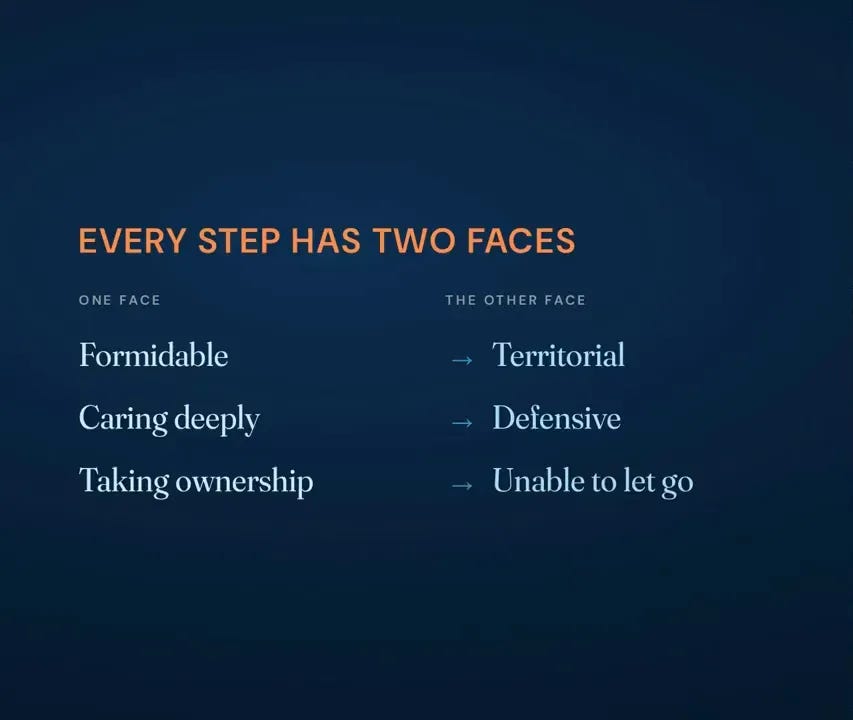
This is mine can mean taking responsibility for something nobody assigned to you. It can also mean, “That is my turf. Stay out.”
Caring deeply can help someone spot a problem before it breaks. It can also make a simple question about the work feel like a personal attack.
Acting as though it is yours can produce initiative and extra effort. It can also make someone refuse to hand over a task because nobody else will do it properly.
This is me can create extraordinary commitment. It can also make a business decision feel like a decision about the person themselves.
This last one can be the most expensive. When the work becomes the self, criticism of the work feels like criticism of you. A change in direction can feel like self-betrayal. Letting go of part of the business can feel like losing part of yourself.
That is why letting go is harder than people admit.
Discernment Creates Space for Choice
The first response to unhealthy ownership is not another action item. It is a shift in awareness.
Psychological ownership is already operating in you and in the people around you. It is often running underneath conscious attention. When it runs unseen, it runs you.
But when you can describe it and notice it, you create space between yourself and the process. From that space, you can observe it.
This is discernment: the ability to examine something without immediately calling it good or bad.
Discernment lets you ask:
Where is my ownership serving the work and the people around me?
Where has it become defensive, territorial, or controlling?
Is this part of the business mine, or has it become me?
What would become possible if I handed some of it over?
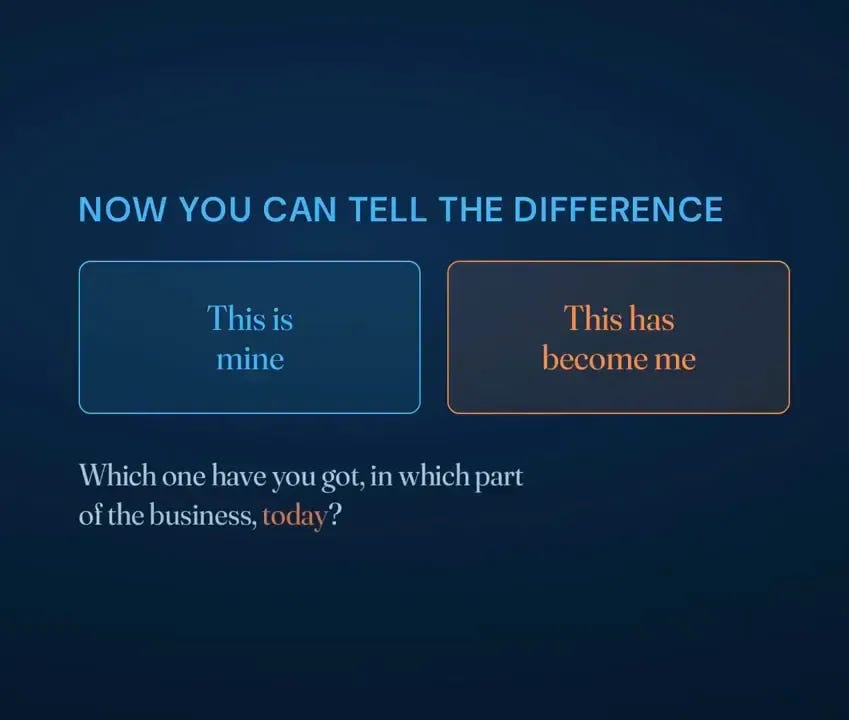
Awareness does not remove ownership, and you would not want it to. It gives you some control over how you carry ownership of a project, a role, a business unit, or the whole company.
You Cannot Give Ownership, But You Can Invite Someone to Find It
Telling people to take ownership does not create ownership. No amount of equity guarantees it either.
What a question can do is invite a person to look.
When you ask someone to imagine the business disappearing or thriving without any threat to their own security, they have to look at where the business sits in relationship to them.
Is this simply a place where I work? Or does some part of me experience this as mine?
Once they see that relationship, they can begin to notice what follows from it:
What do I feel?
What do I care about?
What would I do?
The conversation is not measuring ownership from the outside. It is making the ownership loop visible from the inside.
Ask once, and ownership becomes something that can be named. Ask regularly, and the language can spread through the organization. Managers ask their people. Their people ask theirs. Over time, people may begin having better conversations about their relationship to the work without anyone forcing a slogan on them.
That is the beginning of a culture of positive ownership.
Use the Exercise to See the Other Face Too
The same conversation can reveal ownership that has become unhealthy.
It may show someone who cannot let go of a piece of the business. Someone who hears ordinary questions as threats. Someone whose sense of responsibility has become territory.
Healthy ownership is not simply about having more ownership. It is about being able to see what kind of ownership you have.
And do not stop with your direct reports. Turn the questions on yourself.
You may be too close to your own business to do this cleanly alone. Find someone you trust who knows the business well enough that you do not have to explain every detail, and with whom you can answer honestly. A coach, counselor, spouse, or trusted advisor may be able to ask the questions in a way that lets you see what proximity has hidden.
The Performance You Want May Already Be Inside the Company
Ownership changes how people think, feel, and behave. It changes what they can bring to the work.
Much of the performance leaders search for may not be outside the company, waiting to be hired. It may already be present in people who could bring far more than they currently bring.
What is missing is not always effort. Sometimes it is the relationship they have with the work.
A person who genuinely owns what they are doing does not always look like they are working harder. Sometimes they come alive in the work. Like a dancer who stops thinking through every movement and simply becomes immersed in it, their performance can begin to feel almost effortless.
That is very different from trying to squeeze more output from people.
Start small. One person. Twenty minutes. Two questions. Then pay attention to what happens while they answer.
That is where ownership becomes visible.
Dive Deeper
Want to dive deeper? I have created yet another experience for you to work with.
Click the button below to engage with this episode in yet another way.


