

Are your people lazy, or are they drained?
The person who does the minimum on Monday may also coach a soccer team on Saturday, organize a school fundraiser in the evenings, and rebuild a car engine in the garage. The initiative is there. The energy is there. The capacity is there.
It is just going somewhere else.
That should make us question how we think about employee performance. Perhaps the answer is not to push harder. Perhaps it is to understand why capable people come alive in one setting and shut down in another.
Olympic figure skating champions Tara Lipinski and Alysa Liu offer a useful way to explore that question. One discovered something almost by accident. The other made a deliberate practice of it. Both point toward what I call enlivening performance: performance that makes us come alive rather than wears us out.
Key Takeaways
Enlivening performance energizes people through the work itself rather than steadily depleting their capacity.
Managing whole human beings requires attention beyond observable behavior and trained intellect.
Emotions offer clues about friction and deeper misalignment between people and their work.
Four questions can reveal friction, identify alignment, invite ownership, and clarify the manager’s support.
About this article. This is episode 52 of The Business Philosopher Within You podcast, Employee Performance. The Way You See Your People Is How You Manage Them. The video above is that episode. The YouTube version is at the bottom of this post.
The video is the original work. This written version was drafted by an AI tool, videotoblog.ai, from the recording, and I edited it only lightly, so read it as a companion to the conversation rather than as something I wrote. The prose here is not mine.
Start With One Person and Four Questions
Before getting into the philosophy, here is something practical you can do today. Sit down with one direct report and have a short conversation.
You do not need to redesign your entire organization first. You need four questions, a willingness to listen, and one commitment you will actually keep.
1. What is one thing in your work that drains you?
Start with one thing. Not a complete inventory of everything wrong with the job.
If the person wants to explore further, you can ask for more. But one concrete answer gives you somewhere to begin.
2. What is one thing in your work that makes you come alive?
Some people find this question harder to answer. If they struggle, try asking what comes naturally to them.
Or make the question more tangible: imagine starting the day with a mild cold or headache. What activity could absorb your attention so completely that, for a little while, you forgot you felt unwell?
The point is not that work cures illness. It is to help someone recognize the activities that engage them deeply, rather than asking them to produce an abstract statement about their passion.
3. How could you rearrange your work to do more of what energizes you and less of what drains you?
Notice who is being asked to think about the rearrangement. You are not immediately prescribing a solution. You are inviting the person to take ownership of how they work and perform.
4. What can I do as your manager to help you make that change?
Do not skip this question. Without it, the conversation can become an exercise in asking someone to describe a problem and then leaving them alone with it.
Ask what help they need. Then give them room to answer.
Before the meeting ends, commit to one small thing that can happen right away. Then follow through. The conversation can take only a few minutes, but its value depends on what you do afterward.
Tara Lipinski: Finding Freedom Without Eliminating Fear
At the 1998 Winter Olympics in Nagano, Japan, Tara Lipinski was 15 years old. Michelle Kwan was the favorite and one of the outstanding skaters of her generation.
The two approached the Olympic experience differently. Kwan, nursing an injury, arrived later and stayed in a hotel with her parents, apart from the athletes’ village. Lipinski moved into the village, ate in the cafeteria, attended the opening ceremony, and spent time with the hockey team. She treated the Olympics as an opportunity to enjoy herself.
That did not mean she was fearless.
About 20 minutes before her free skate, Lipinski locked herself in a bathroom, shaking, and called her mother. She felt she could not do it.
Her mother did not demand that she stop being frightened. She acknowledged the fear, reassured her that she could skate anyway, and reminded her that she was loved.
Lipinski was still shaking when she stepped onto the ice. But after landing her first jump, she settled into the zone.
Both Lipinski and Kwan landed seven triple jumps. Kwan’s coach later described her performance as somewhat restrained. Lipinski skated with freedom and abandon, and won the gold.
The lesson is not that enjoying the athletes’ village wins Olympic medals. It is that technical capability does not tell the whole story of performance. How freely a person can bring that capability into the moment matters, too.
At 15, Lipinski was not advancing a management philosophy. She found that freedom through enjoying the experience, supported by someone who understood what she needed in a difficult moment.
Alysa Liu: Making Enjoyment and Ownership Deliberate
Alysa Liu’s path was different.
A skating prodigy, she walked away from the sport at 16 after the Beijing Olympics. Two years later, she returned, but on her own terms.
She chose her music. She had a say in how much she trained and what she ate. Her coaches became collaborators rather than simply people issuing instructions.
Her approach put loving the work ahead of being consumed by the result. She would compete wholeheartedly, but a medal would not be the sole condition that made the experience worthwhile.
At the 2026 Winter Olympics in Milan, she won gold, becoming the first American woman to win the individual Olympic title in 24 years.
She continued to make choices on her own terms afterward, taking the following season off to recalibrate while expressing her intention to return.
This is not apathy. It is not a declaration that results do not matter. Liu competes intensely. What changed was her relationship with the work, the people supporting her, and the outcome.
What Lipinski stumbled into, Liu made intentional. Enjoyment and ownership were not rewards to be postponed until after the hard work. They became part of how she approached the work itself.
Why This Only Looks Like a Revolt
In a sporting culture organized around pushing harder, an athlete who insists on enjoying the process can look rebellious. Stress and burnout are often treated as unavoidable costs of ambition.
Business has its own version: hustle culture, endless hours, and burning the candle at both ends.
But refusing to organize work around depletion is not necessarily a revolutionary act. It may simply mean recognizing that the old approach does not serve performance well.
I am not making a moral argument that we ought to treat people better, important as that is. I am making a performance argument.
If the way you manage exhausts the very capacity you hired someone to contribute, it limits your business. The question is not whether you can extract more effort today. It is whether your management approach helps people bring more of themselves to the work over time.
And if figure skating is not your sport, the same distinction is recognizable in music, theater, or any other demanding performance. Discipline and vitality are not opposites.
Would You Manage a Person Like a BMW?
I am an electrical engineer by education, so indulge an engineering analogy.
A familiar way to think about machine performance is the relationship between output and input. In energy terms, useful output is less than input because some energy is lost along the way. Moving parts rub against one another, and friction turns some of that energy into heat.
Run the machine harder and you may get more output. You also get wear and tear. Eventually, you wear it out.
This way of thinking is useful for machines. It helped build the modern economy. The problem is that it followed us into knowledge work.
We organize management systems around output and productivity, then begin to regard people much as we regard a BMW: how much can we get out of it, and how do we reduce whatever interferes?
Output matters. But output alone is not a complete way to understand a human being.
The same concern appears in employee engagement research. Gallup has reported engagement levels below one in three employees and, in its research on engagement and business outcomes, an 18% productivity difference between the most and least engaged teams.
Those findings should prompt a question about untapped capacity, not merely a judgment about effort. If capable people are disengaged, what is happening between the potential they bring and the performance the organization receives?
Seven Human Faculties, but Only Two Gears in Use
Here is the framework I use to look beyond the machine model.
Traditional management tends to concentrate on two human faculties: behavior, meaning what people do, and intellect, meaning what they know and how they think. We train the intellect and measure the behavior.
But I find it more useful to consider seven faculties:
Behavior: What we do.
Vitality: The energy that makes us want to get up and participate.
Emotion: What we feel.
Intellect: How we think, reason, and understand.
Identity: Our sense of who we are.
Wisdom: Our deeper judgment about what truly matters.
Awareness: Our capacity to notice what is happening.
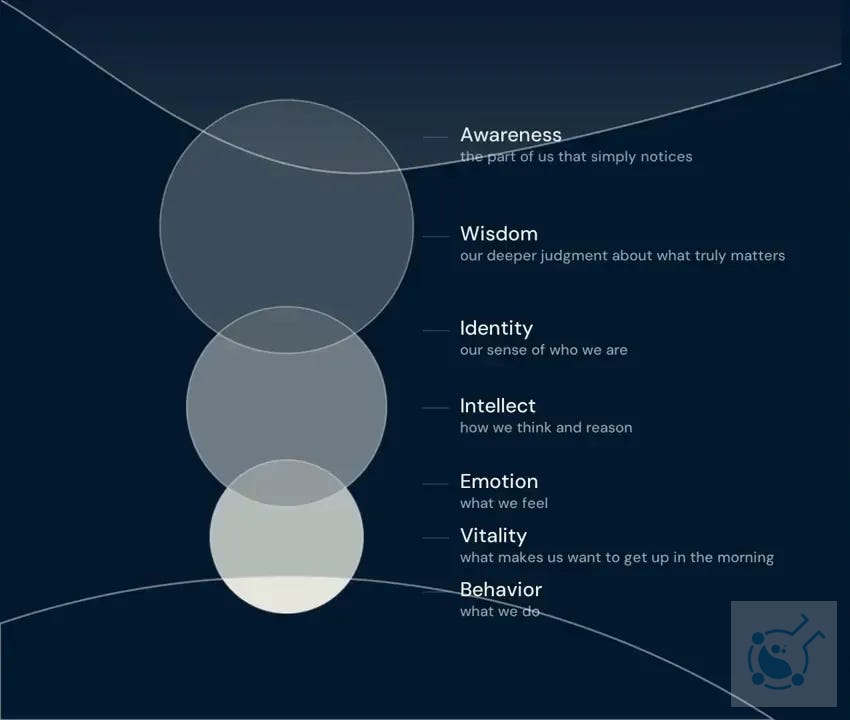
Think of a car with seven gears that you only ever drive in two. You have access to much more than you are using.
The analogy is imperfect, of course. People are not cars. That is precisely the point: when you hire someone, you invite a whole human being into your organization, not just a set of observable behaviors and a trained intellect.
How you understand your people shapes how you manage them. Regard them as machines and your management will follow that assumption. Recognize whole human beings and different questions become possible.
The management inheritance we need to reconsider
This is not an accusation against founders or managers. We inherited a way of thinking shaped by industrial work.
My argument is that, as management organized work around machinery and measurable production, it pushed much of the human being out of its field of attention. When work became knowledge work, we did not fully restore what had been left out.
That inheritance persists in management literature, MBA curricula, and leadership training. Those of us who write, teach, and run seminars bear responsibility for questioning it.
The cost is a self-reinforcing cycle. People contribute less than they could, become dissatisfied with the experience, and then contribute even less. More pressure can leave the underlying problem untouched.
The shift is not away from performance. It is toward a more complete understanding of what produces it.
Human Friction Is Often Misalignment
If friction explains some of the gap between a machine’s input and useful output, what does friction look like in a person, a team, or an organization?
It can be anything weighing people down. But a major source is misalignment between who people are and the work they spend their days doing.
Their purpose, vision, values, or sense of identity may be out of step with their responsibilities. They may know how to do the work while finding little in it that draws on their vitality or deeper judgment.
In this framework, purpose, vision, and execution draw on those seven faculties. A team also has a collective purpose, vision, and set of values.
This does not mean every individual must match the team perfectly. It means alignment deserves an ongoing conversation. It is not something you can safely assume because someone accepted an offer or completed their onboarding.
That is where the four questions become useful. They make the conversation specific: what is draining this person, what engages them, and what could change?
Emotions Tell You Where to Look
How do you recognize friction before it becomes another disappointing performance review?
Pay attention to emotions, including your own.
Possible signs of lower friction: Ease, joy, confidence, clarity, and calm.
Possible signs of higher friction: Apathy, resentment, fear, anger, and sadness.
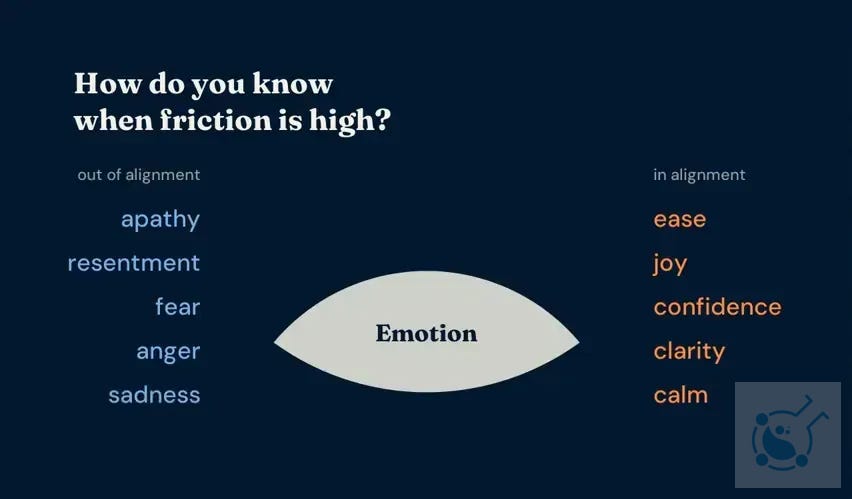
These are clues, not a complete diagnosis. Emotions are the surface expression of what is happening structurally and psychologically underneath.
The answer is not to instruct people to be cheerful. It is to explore what their experience is telling you about the work and the environment around it.
Remember Lipinski’s mother. She did not eliminate her daughter’s fear. She made room for it while affirming her ability to perform.
That distinction matters for leaders. You cannot make someone feel alive. You can help create an environment in which they perform with less friction and more clarity, confidence, and ease.
A culture that supports performance does not have to deny difficult emotions. It can acknowledge them without making them another reason to judge the person.
Enlivening Performance Versus Draining Performance
Draining performance is familiar. It is the work that leaves you dreading the next morning. You keep producing, but the act of producing steadily depletes you.
It follows the machine logic: run harder, get more, keep going until there is little left.
Enlivening performance has a different quality. The activity itself engages and energizes you. You are not continually preoccupied with how hard you are trying. You are absorbed in doing the work.
From the outside, this can look effortless. That does not mean it required no effort to develop. A great performer may bring decades of practice and dedication to a moment that appears easy.
The important distinction is between the discipline that builds capability and the strain that interferes with expressing it.
Enlivening performance goes beyond making the work look easy. The act of performing makes the person feel more alive. In corporate language, we might call that fulfillment.
It is the quality athletes describe when they stop overthinking and become fully present in the performance. It is not the absence of preparation or ambition. It is a different way of bringing both into action.
Why the Four Questions Can Make a Difference
A short conversation may sound too small to matter. But each question serves a distinct purpose.
Asking what drains someone identifies friction. It brings a specific source of lost energy into the open.
Asking what makes them come alive identifies alignment. It reveals where their work already connects with their natural energy.
Asking how they would rearrange the work invites ownership. They participate in shaping their performance rather than waiting for instructions.
Asking what you can do to help changes your role. You become responsible for support, not merely measurement.
You will also discover that what drains one person may energize another.
Alphabetizing files, making a to-do list, or preparing a presentation can feel burdensome to one person and deeply satisfying to someone else. Some people even enjoy meetings. I happen to be one of them, provided we mean the good ones, not three hours of rambling.
You cannot assume that your own preferences explain everyone else’s experience.
The fourth question is especially important because it asks you to reconsider how you see the person. It is difficult to sincerely ask how you can support someone’s vitality while continuing to regard them as a machine.
Small action matters when it is aligned
It is not simply action that makes the difference. It is aligned action.
When a change is supported by a person’s energy, emotions, thinking, and sense of identity, a small step can have an impact out of proportion to its size.
And remember the method: you are asking, not telling.
When your direct reports begin having the same conversation with their own teams, the practice can spread toward the front line. Culture takes shape through repeated questions, conversations, and commitments that people keep.
That is how you begin building the support system for enlivening performance, rather than demanding more output from an increasingly depleted workforce.
Turn the Questions Around on Yourself
This applies to the founder, manager, and leader, too.
How you understand your own role shapes how you manage yourself, develop, and improve. If you treat yourself as a machine, you may reproduce the same draining pattern you are trying to change for everyone else.
Ask yourself:
What in my work drains me?
What makes me come alive?
How could I rearrange my work to do more of what energizes me and less of what depletes me?
How can I help create a company culture that supports this way of working, and who can help me?
As these conversations develop, another question emerges. Much of what energizes a person existed long before they joined your company. It reflects abilities, traits, and qualities they already brought with them.
That has implications for hiring. Are you looking only for skills, or are you also paying attention to the innate qualities that help someone come alive in the work?
You do not need to resolve every implication today. Begin with one person, four questions, careful listening, and one concrete act of support.
Then test the idea. Challenge it. Notice what changes in your organization and what does not.
Organizations that can outlive their founders are not built by leaders who already have every answer. They are built by people willing to ask better questions, including questions about what performance really means.
Dive Deeper
Want to dive deeper? I have created yet another experience for you to work with.
Click the button below to engage with this episode in yet another way.


